

For years, many retail investors in India relied mainly on fixed deposits for stable returns. But in today’s changing financial landscape, more investors are discovering another fixed income avenue — bonds.
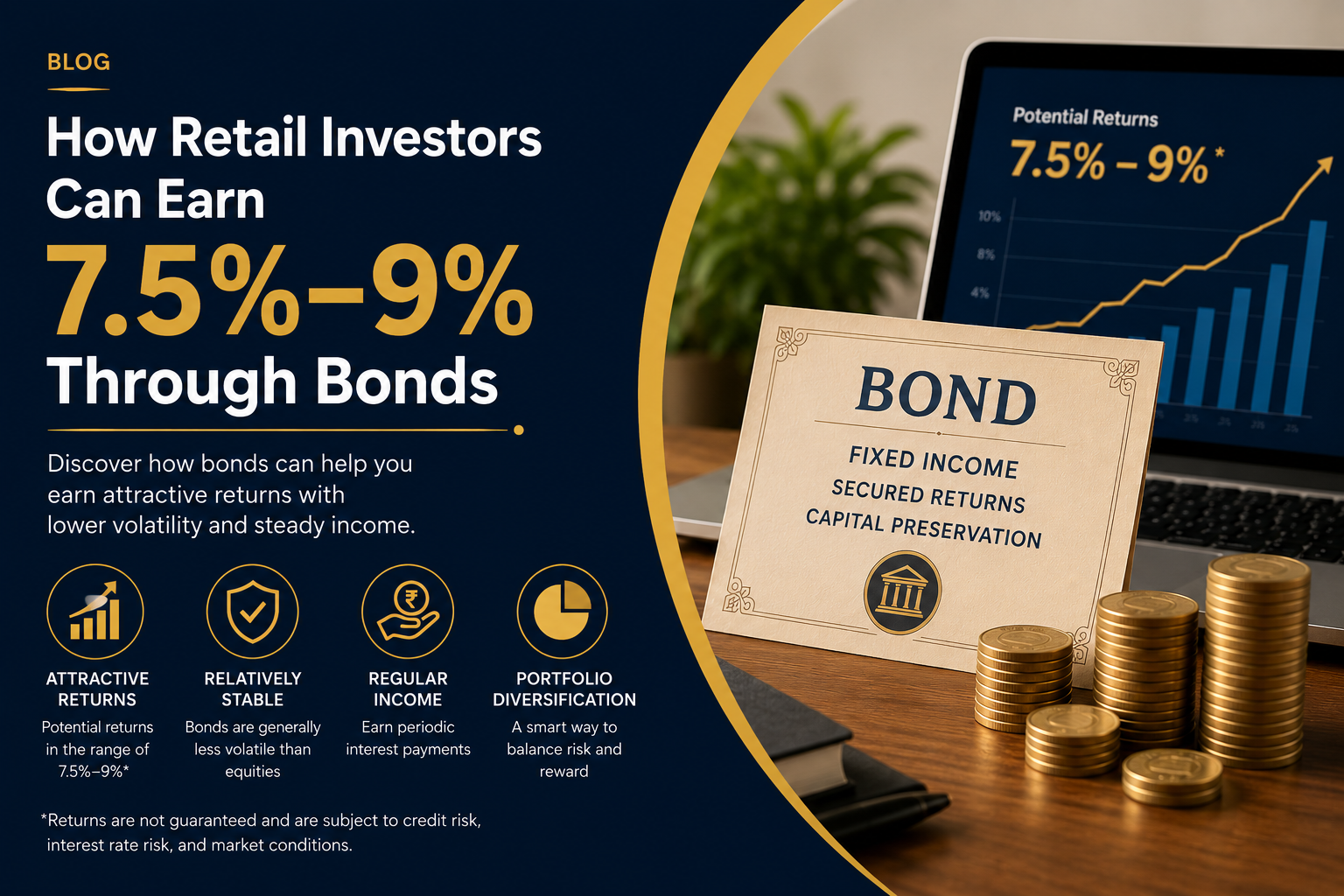
With interest rates remaining attractive and debt markets expanding, carefully selected bonds are offering potential returns in the range of 7.5%–9%, making them an increasingly popular option for investors looking for regular income, diversification, and relative stability.
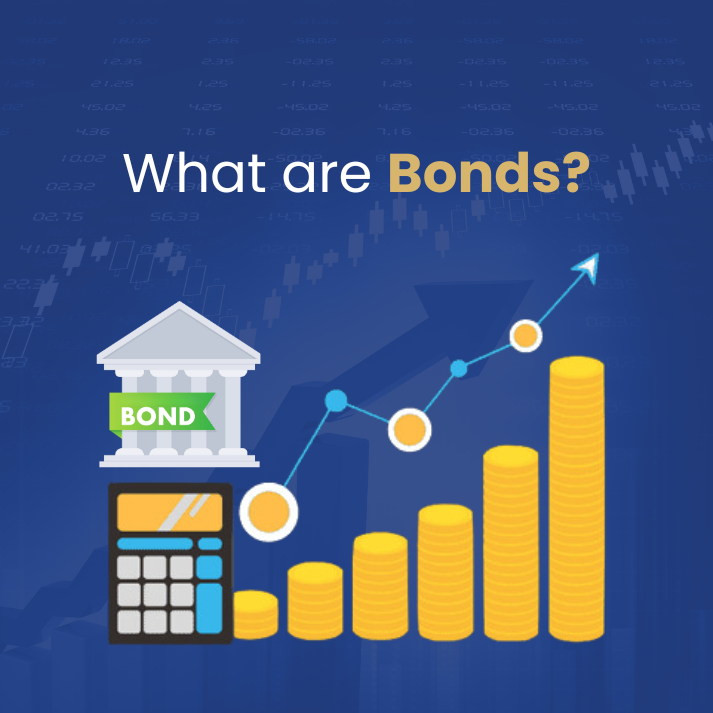
What Are Bonds?
A bond is essentially a loan given by investors to a company, financial institution, or government entity.
In return, the issuer pays:
- Fixed interest (coupon payments)
- Principal amount at maturity
Unlike traditional savings instruments, bonds can offer comparatively higher yields depending on:
- Credit quality
- Tenure
- Market conditions
- Issuer type
Why Are Retail Investors Looking at Bonds Now?
Several factors are driving interest toward bonds:
1. Attractive Yields
Many high-quality corporate bonds currently offer yields higher than traditional fixed deposits.
2. Market Volatility
Equity markets can fluctuate sharply. Bonds may help bring balance and predictability to portfolios.
3. Regular Income Potential
Certain bonds provide periodic interest payouts, which may suit income-focused investors.
4. Portfolio Diversification
A diversified portfolio often includes both growth-oriented and stability-oriented assets.
How Can Investors Earn 7.5%–9%?
Returns in this range are typically available through selected:
- Corporate bonds
- Non-convertible debentures (NCDs)
- Secured debt instruments
- High-yield fixed income opportunities
However, returns depend on risk profile and issuer quality.
Key Factors That Influence Bond Returns
Credit Rating
Higher-rated bonds generally offer lower risk but slightly lower returns.
Lower-rated bonds may offer higher yields but involve higher risk.
Tenure
Longer-duration bonds may provide higher yields depending on interest rate expectations.
Interest Rate Cycle
Bond prices and yields are influenced by RBI policy rates and overall liquidity conditions.
Types of Bonds Retail Investors Explore
Government Bonds
- Backed by the government
- Lower risk
- Usually moderate returns
PSU Bonds
- Issued by public sector undertakings
- Often considered relatively stable
Corporate Bonds
- Issued by private companies
- Can offer higher yields
Tax-Free Bonds
- Interest income may be tax efficient in certain cases
- Popular among long-term investors
Important Risks Investors Should Understand
While bonds are generally considered more stable than equities, they are not completely risk-free.
Credit Risk
The issuer may delay or fail to repay obligations.
Interest Rate Risk
Bond prices may fluctuate when interest rates change.
Liquidity Risk
Some bonds may not be easily tradable before maturity.
This is why understanding issuer strength and investment suitability is important before investing.
Who Can Consider Bonds?
Bonds may suit investors who are looking for:
- Predictable income potential
- Portfolio diversification
- Reduced volatility compared to equities
- Medium- to long-term financial planning
- Stability-oriented investment allocation
Final Thoughts
In an environment where investors are increasingly seeking balance between growth and stability, bonds are gaining attention as an important component of modern portfolios.
With proper research, diversification, and risk assessment, retail investors can explore opportunities that may offer returns in the range of 7.5%–9% while aligning with their financial goals and risk appetite.
Smart investing is not only about chasing returns — it is also about building financial confidence through informed decisions.
Bonds Partners
Helping investors explore fixed income opportunities with confidence.
visit – www.bondspartners.com
Share this content: