
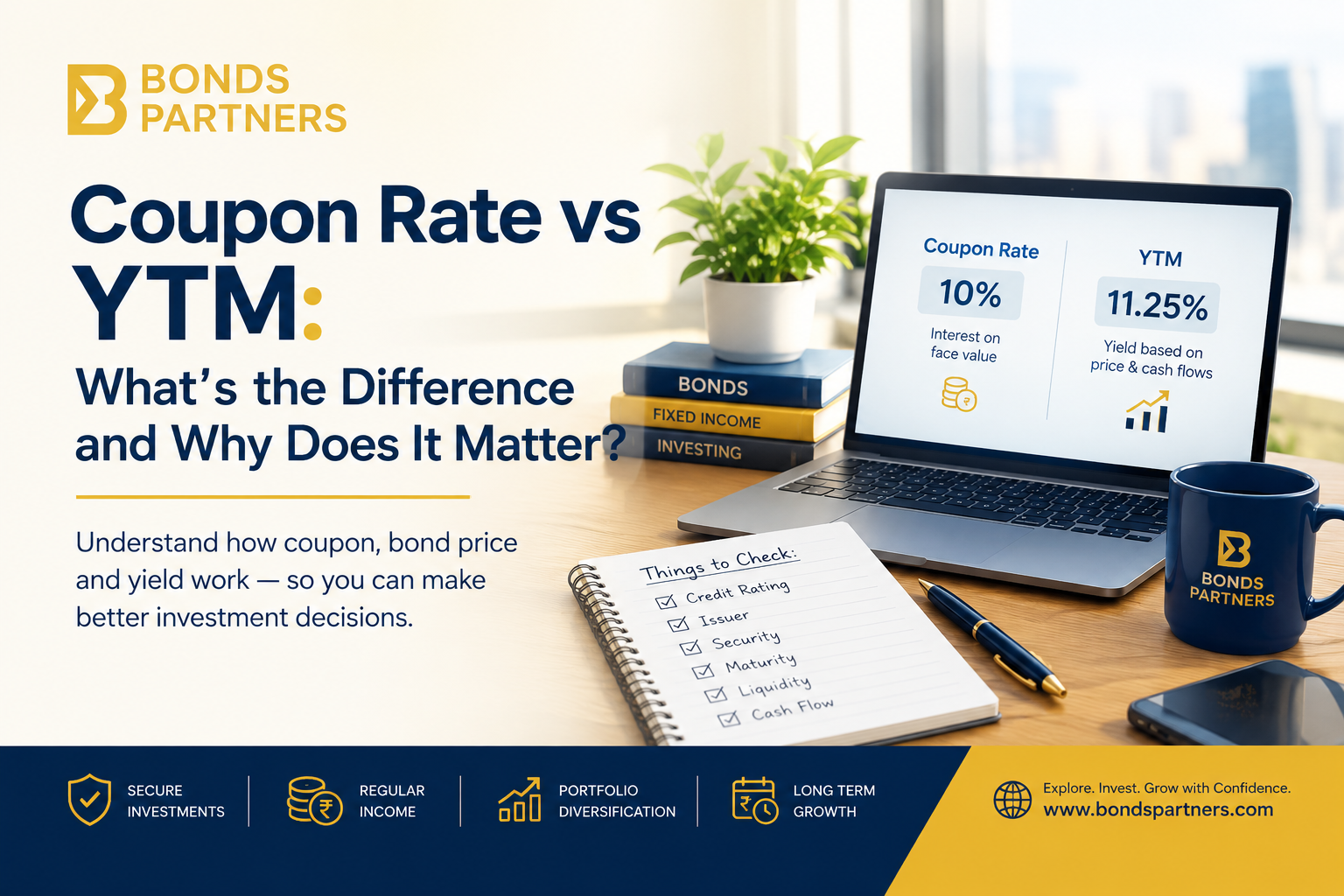
You’re checking a bond and see:
Coupon Rate: 10%
YTM: 11.25%
The obvious question is: if the bond pays 10%, where does the 11.25% come from?
This is one of the most common questions for new bond investors. The answer is actually quite simple once you understand the role of the bond’s price.
First, What Is the Coupon Rate?
The coupon rate is the interest a bond pays on its face value.
For example:
Face Value: ₹1,000
Coupon Rate: 10% p.a.
Annual Coupon: ₹100
So, a 10% coupon on ₹1,000 means ₹100 in annual interest, subject to the bond’s terms.
Depending on the bond, this interest may be paid monthly, quarterly, semi-annually or annually.
Here’s the important part: the coupon on a fixed-rate bond doesn’t change just because its market price changes.
A ₹1,000 face-value bond may be available for ₹950 or ₹1,050 in the secondary market, but its fixed coupon is still calculated on ₹1,000.
And that brings us to YTM.
What Is YTM?
Yield to Maturity (YTM) looks beyond the coupon.
It considers the price you pay for the bond, remaining coupon payments, redemption value and time left until maturity.
In simple terms:
Coupon Rate = What the bond pays on its face value
YTM = Yield implied by the price you pay and the bond’s remaining cash flows
That’s why a 10% coupon bond doesn’t always have a 10% YTM.
Let’s Understand It With One Example
Suppose a bond has:
Face Value: ₹1,000
Coupon: 10%
Annual Interest: ₹100
Now the market price changes.
| You Buy At | What It Means | YTM |
|---|---|---|
| Below ₹1,000 | Bond is at a discount | Generally higher than 10% |
| ₹1,000 | Bond is at par | Generally around 10% |
| Above ₹1,000 | Bond is at a premium | Generally lower than 10% |
Why?
If you buy below ₹1,000 and the bond is eventually redeemed at ₹1,000, the difference between your purchase price and redemption value contributes to the yield.
If you pay more than ₹1,000 but receive ₹1,000 at maturity, that premium works in the opposite direction.
So the easiest rule to remember is:
Bond Price ↓ = Yield ↑
Bond Price ↑ = Yield ↓
Why Do Bond Prices and YTM Change?
The coupon of a fixed-rate bond normally stays the same, but its market price can move.
One major reason is interest rates.
Suppose newly issued bonds with similar credit characteristics start offering higher rates. An older bond with a lower coupon may become less attractive at its existing price. Its price may fall, which pushes its yield higher.
Bond prices can also be affected by the issuer’s credit profile, remaining maturity, market liquidity and demand and supply.
This is why YTM can keep changing even though the coupon rate remains fixed.
Coupon Rate, Current Yield and YTM Aren’t the Same
Here’s another quick example.
Suppose:
Face Value: ₹1,000
Coupon: 10%
Annual Interest: ₹100
Market Price: ₹950
The coupon rate remains 10%.
The current yield is approximately:
₹100 ÷ ₹950 × 100 = 10.53%
But YTM goes further. It also considers the remaining time to maturity and the difference between your purchase price and the redemption value.
So:
Coupon → based on face value
Current Yield → coupon compared with current price
YTM → considers price and remaining cash flows until maturity
Does Higher YTM Mean a Better Bond?
Not necessarily.
Imagine:
Bond A → YTM 8.5%
Bond B → YTM 12.5%
It’s easy to look at Bond B and think, “Higher yield, better option.”
But there’s a more important question:
Why is this bond offering a higher yield?
A higher YTM can sometimes reflect differences in credit risk, liquidity, maturity, security structure or other bond-specific factors.
So instead of looking only for the highest YTM, understand what sits behind that number.
Is YTM a Guaranteed Return?
No.
YTM is a calculated yield based on certain assumptions, including holding the bond until maturity and receiving scheduled coupon and principal payments.
Your actual return can be different if:
- You sell the bond before maturity
- The issuer delays or defaults on payments
- Reinvestment rates change
- The bond is called before maturity
- Taxes or transaction costs affect your returns
Think of YTM as a useful comparison measure, not a guaranteed return.
Before Investing, Look Beyond YTM
When you find an interesting bond, don’t stop at the coupon or YTM.
Check:
Credit Rating — What does the latest rating indicate about the issuer’s creditworthiness?
Issuer — Who is borrowing the money, and what does its financial position look like?
Security — Is the bond secured or unsecured? What does the security structure actually cover?
Maturity — When is your principal scheduled to come back?
Cash Flow — Are coupon payments monthly, quarterly, semi-annual or annual?
Liquidity — What happens if you want to sell before maturity?
These details give you a much better picture than yield alone.
The Simple Takeaway
The difference between Coupon Rate and YTM doesn’t need to be complicated.
Remember:
Coupon Rate = Interest paid on the bond’s face value
YTM = Yield implied by the price you pay and the bond’s remaining cash flows
So the next time you see a bond offering a high YTM, don’t just ask:
“How high is the yield?”
Ask:
“Why is the yield this high?”
That question can tell you much more about the bond you’re considering.
Explore. Compare. Understand before you invest.
Bonds Partners
Disclaimer: This content is for educational and informational purposes only and should not be considered investment advice or a recommendation. Bond investments are subject to credit, liquidity, interest-rate and market risks. Investors should review the relevant documents, terms and risk factors before investing.
Share this content: